Search: "User"
Querying the top item by group with peewee ORM
In this post I'd like to share some techniques for querying the top item by group using the Peewee ORM. For example,
- List the most recent tweet by each of my followers.
- List the highest severity open bug for each of my open source projects.
- List the latest story in each section of a news site.
This is a common task, but one that can be a little tricky to implement in a single SQL query. To add a twist, we won't use window functions or other special SQL constructs, since they aren't supported by SQLite. If you're interested in finding the top N items per group, check out this follow-up post.
Integrating the flask microframework with the peewee ORM
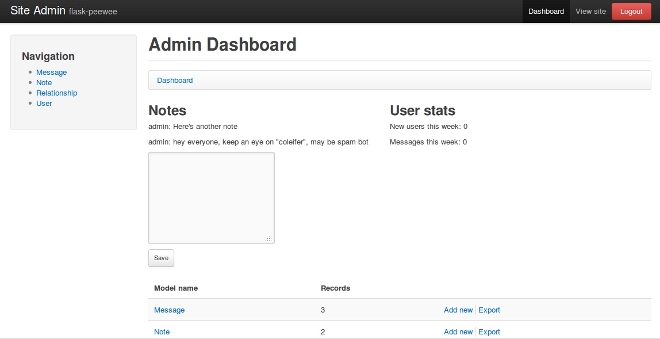
I'd like to write a post about a project I've been working on for the past month or so. I've had a great time working on it and am excited to start putting it to use. The project is called flask-peewee -- it is a set of utilities that bridges the python microframework flask and the lightweight ORM peewee. It is packaged as a flask extension and comes with the following batteries included:
- Admin interface a-la django
- RESTful API toolkit a-la tastypie
- Authentication system
Querying the top N objects per group with Peewee ORM
This post is a follow-up to my post about querying the top related item by group. In this post we'll go over ways to retrieve the top N related objects by group using the Peewee ORM. I've also presented the SQL and the underlying ideas behind the queries, so you can translate them to whatever ORM / query layer you are using.
Retrieving the top N per group is a pretty common task, for example:
- Display my followers and their 10 most recent tweets.
- In each of my inboxes, list the 5 most recent unread messages.
- List the sections of the news site and the three latest stories in each.
- List the five best sales in each department.
In this post we'll discuss the following types of solutions:
- Solutions involving
COUNT() - Solutions involving
LIMIT - Window functions
- Postgresql lateral joins
Dear Diary, an Encrypted Command-Line Diary with Python
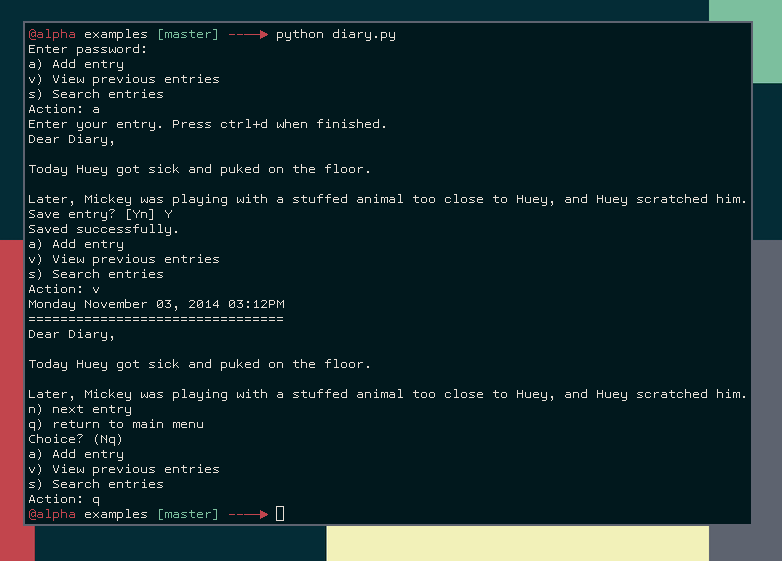
In my last post, I wrote about how to work with encrypted SQLite databases with Python. As an example application of these libraries, I showed some code fragments for a fictional diary program. Because I was thinking the examples directory of the peewee repo was looking a little thin, I decided to flesh out the diary program and include it as an example.
In this post, I'll go over the diary code in the hopes that you may find it interesting or useful. The code shows how to use the peewee SQLCipher extension. I've also implemented a simple command-line menu loop. All told, the code is less than 100 lines!
Misadventures in Python Packaging: Optional C Extensions
I began an unlikely adventure into Python packaging this week when I made what
I thought were some innocuous modifications to the source distribution and
setup.py script for the peewee
database library. Over the course of a day, the setup.py more than doubled in
size and underwent five major revisions as I worked to fix problems arising out
of various differences in users environments. This was tracked in issue #1676,
may it always bear witness to the complexities of Python packaging!
In this post I'll explain what happened, the various things I tried, and how I ended up resolving the issue.
SQLite Database Authorization and Access Control with Python

The Python standard library sqlite3 driver comes with a barely-documented hook for implementing basic authorization for SQLite databases. Using this hook, it is possible to register a callback that signals, via a return value, what data can be accessed by a connection.
SQLite databases are embedded in the same process as your application, so there is no master server process to act as a gatekeeper for the data stored in your database. Additionally, SQLite database files are readable by anyone with access to the database file itself (unless you are using an encryption library like sqlcipher or sqleet). Restricting access to a SQLite database, once a connection has been opened, is only possible through the use of an authorizer callback.
SQLite provides very granular settings for controlling access, along with two failure modes. Taken together, I think you'll be impressed by the degree of control that is possible.
Structuring flask apps, a how-to for those coming from Django
The other day a friend of mine was trying out flask-peewee and he had some questions about the best way to structure his app to avoid triggering circular imports. For someone new to flask, this can be a bit of a puzzler, especially if you're coming from django which automatically imports your modules. In this post I'll walk through how I like to structure my flask apps to avoid circular imports. In my examples I'll be showing how to use "flask-peewee", but the same technique should be applicable for other flask plugins.
I'll walk through the modules I commonly use in my apps, then show how to tie them all together and provide a single entrypoint into your app.
Experimenting with an analytics web-service using python and cassandra
The other day I was poking around my google analytics account and thought it would be a fun project to see if I could collect "analytics"-type data myself. I recalled that the Apache Cassandra project was supposed to use a data model similar to Google's BigTable so I decided to use it for this project. The BigTable data model turned out to be a good fit for this project once I got over some of the intricacies of dealing with time-series data in Cassandra. In this post I'll talk about how I went about modelling, collecting, and finally analyzing basic page-view data I collected from this very blog.
How to make a Flask blog in one hour or less
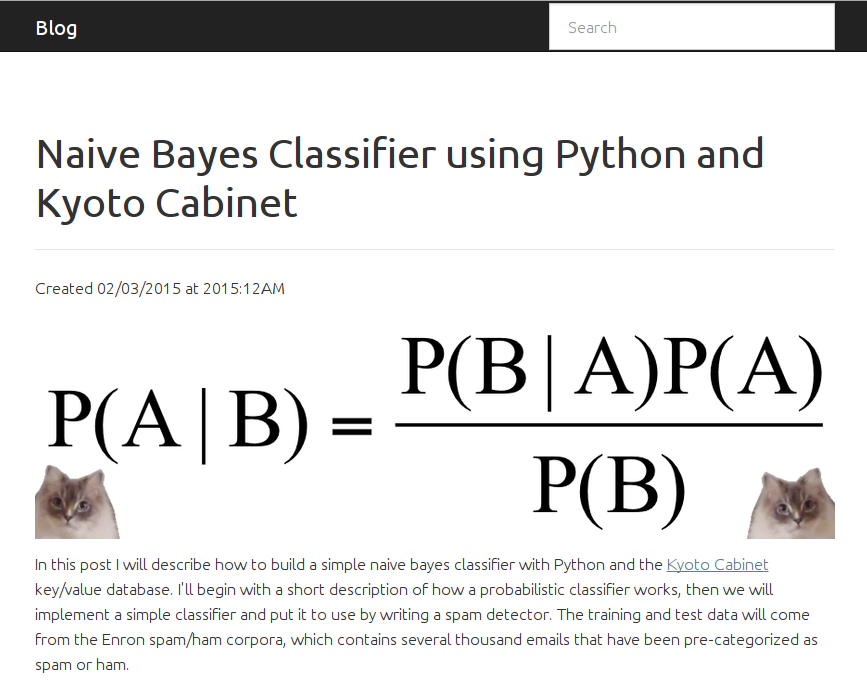
For fun, I thought I'd write a post describing how to build a blog using Flask, a Python web-framework. Building a blog seems like, along with writing a Twitter-clone, a quintessential experience when learning a new web framework. I remember when I was attending a five-day Django tutorial presented by Jacob Kaplan-Moss, one of my favorite projects we did was creating a blog. After setting up the core of the site, I spent a ton of time adding features and little tweaks here-and-there. My hope is that this post will give you the tools to build a blog, and that you have fun customizing the site and adding cool new features.
In this post we'll cover the basics to get a functional site, but leave lots of room for personalization and improvements so you can make it your own. The actual Python source code for the blog will be a very manageable 200 lines.
Who is this post for?
This post is intended for beginner to intermediate-level Python developers, or experienced developers looking to learn a bit more about Python and Flask. For the mother of all Flask tutorials, check out Miguel Grinberg's 18 part Flask mega-tutorial.
The spec
Here are the features:
- Entries are formatted using markdown.
- Entries support syntax highlighting, optionally using Github-style triple-backticks.
- Automatic video / rich media embedding using OEmbed.
- Very nice full-text search thanks to SQLite's FTS extension.
- Pagination.
- Draft posts.
Why I won't be switching to Disque
Disque's alpha release announcement generated some buzz on HackerNews. If you missed it, Disque is a distributed message broker from Salvatore Sanfilippo, the author of Redis.
In the Limitations section of the README, Salvatore has written:
Disque was designed a bit in astronaut mode, not triggered by an actual use case of mine, but more in response to what I was seeing people doing with Redis as a message queue and with other message queues.
This admission makes me wary of using Disque, even if it reaches a stable release, because of my own experience with similar projects I've created but never actually used. These projects are usually fun opportunities for learning, but when it comes to maintenance, my experience has shown me that they quickly become a burden. Usually the problem is masked by the fact that if I'm not using it usually nobody else is either, but in the rare case I do end up with users, then eventually those users are going to submit bug reports and feature requests.
For a problem as complex as a distribute message broker, I imagine that there are going to be a lot of bug reports, strange edge-cases, and feature requests to support exotic use-cases. I hope that, in addition to his work on Redis, Salvatore can find the time to support Disque!
The other reason I don't foresee using Disque is alluded to in the author's own comments. He observes that many people are using Redis as a message broker, and decides that maybe there is a need for a "Redis of messaging". I would say the opposite is true, and that instead of another message server, people want to use Redis!
Redis integrates very nicely into the stack for web-based projects. It can be used as a cache, for locking, as a primary data store, for write-heavy portions of the application, and yes, as a message broker.
Perhaps the reason people are using Redis as a message broker is because they don't want to use something else?