Search: "User"
Peewee, a lightweight Python ORM - Original Post
For the past month or so I've been working on writing my own ORM in Python. The project grew out of a need for a lightweight persistence layer for use in Flask web apps. As I've grown so familiar with the Django ORM over the past year, many of the ideas in Peewee are analagous to the concepts in Django. My goal from the beginning has been to keep the implementation simple without sacrificing functionality, and to ultimately create something hackable that others might be able to read and contribute to.
Self-referencing many-to-many through
How to implement self-referencing many-to-many relationships in Django. Example use cases are modeling asymmetrical following (a-la twitter) or symmetrical friendship (a-la facebook).
Django Patterns: Pluggable Backends
As the first installment in a series on common patterns in Django development, I'd like to discuss the Pluggable Backend pattern. The pattern addresses the common problem of providing extensible support for multiple implementations of a lower level function, be it caching, database querying, etc.
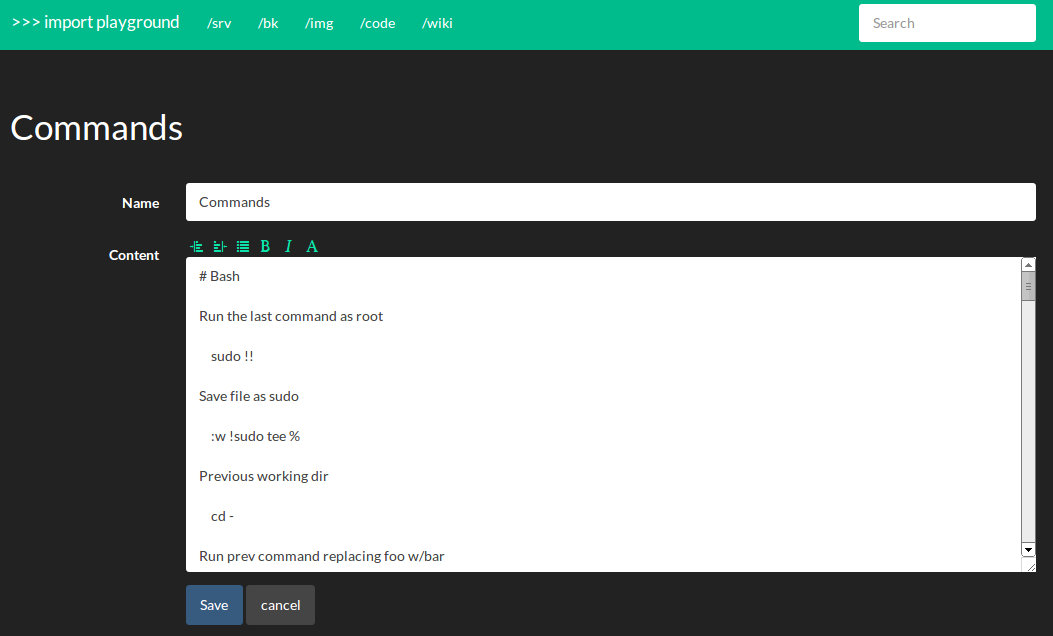
Using Flask blueprints to build a bookmarking app, a pastebin and a wiki
For a change, I've been doing all of my new app development using flask, a python web framework built atop the werkzeug WSGI toolkit. Having used django for the last two years it's been fun to do something different, but at the same time stick with python.
In this post I'd like to show a couple of the small projects I've written using flask over the past few weeks.
Migrating to SQLite

Small. Fast. Reliable. Choose any three.
I made the decision this week to migrate my personal sites and several other sites I host onto SQLite. Previously almost everything I hosted had been using Postgresql. The move was motivated by a couple factors:
- SQLite is awesome!
- Self-contained: does not require a separate server process
- Data is stored in a single file, simplifying backups
- Excellent Python (and peewee) support
- Full-text search
At times it has seemed to me that there is a tacit agreement within the Flask / Django communities that if you're using SQL you should be using Postgresql. Postgresql is an amazing piece of engineering. I have spent the last five years of my career working exclusively with it, and I am continually impressed by its performance and the constant stream of great new features.
So why change things?
Well, as my list indicates, there are a handful of reasons. But the primary reason was that I wanted something lightweight. I'm running a fairly low-traffic, read-heavy site, so Postgresql was definitely overkill. My blog is deployed on a VPS with very limited resources, so every MB of RAM counts. Additionally, I wasn't using any special Postgresql features so there was nothing holding me back.
(continued...)
Encrypted SQLite Databases with Python and SQLCipher
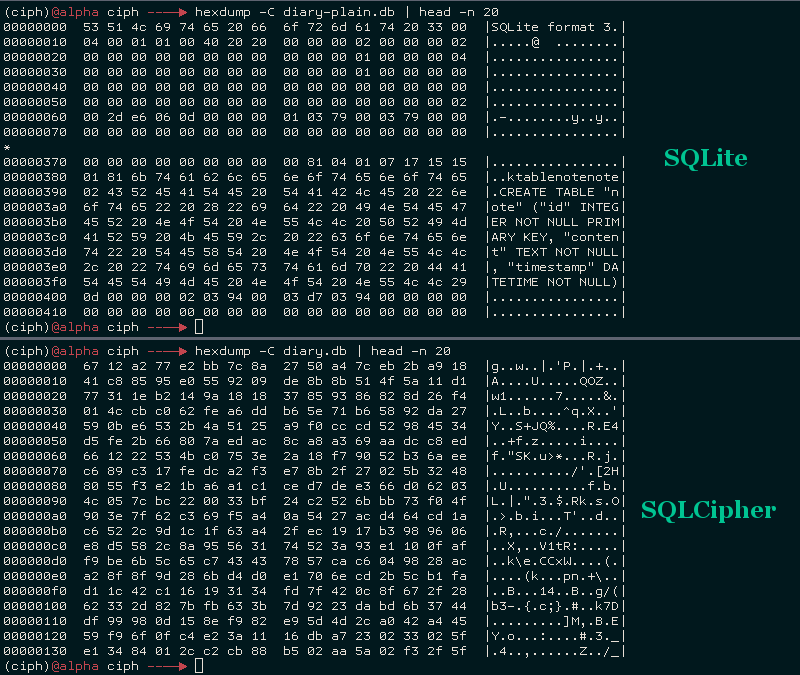
SQLCipher, created by Zetetic, is an open-source library that provides transparent 256-bit AES encryption for your SQLite databases. SQLCipher is used by a large number of organizations, including Nasa, SalesForce, Xerox and more. The project is open-source and BSD licensed, and there are open-source python bindings.
A GitHub user known as The Dod was kind enough to contribute a sqlcipher playhouse module, making it a snap to use Peewee with SQLCipher.
In this post, I'll show how to compile SQLCipher and the sqlcipher3 python bindings, then use peewee ORM to work with an encrypted SQLite database.
Going Fast with SQLite and Python
In this post I'd like to share with you some techniques for effectively working with SQLite using Python. SQLite is a capable library, providing an in-process relational database for efficient storage of small-to-medium-sized data sets. It supports most of the common features of SQL with few exceptions. Best of all, most Python users do not need to install anything to get started working with SQLite, as the standard library in most distributions ships with the sqlite3 module.
Saturday morning hacks: Building an Analytics App with Flask

A couple years back I wrote about building an Analytics service with Cassandra. As fun as that project was to build, the reality was that Cassandra was completely unsuitable for my actual needs, so I decided to switch to something simpler. I'm happy to say the replacement app has been running without a hitch for the past 5 months taking up only about 20 MB of RAM! In this post I'll show how to build a lightweight Analytics service using Flask.
Optimistic locking in Peewee ORM

In this post I'll share a simple code snippet you can use to perform optimistic locking when updating model instances. I've intentionally avoided providing an implementation for this in peewee, because I don't believe it will be easy to find a one-size-fits-all approach to versioning and conflict resolution. I've updated the documentation to include the sample implementation provided here, however.
Kyoto Tycoon in 2019

I've been interested in using Kyoto Tycoon for some time. Kyoto Tycoon, successor to Tokyo Tyrant, is a key/value database with a number of desirable features:
- On-disk hash table for fast random access
- On-disk b-tree for ordered collections
- Server supports thousands of concurrent connections
- Embedded lua scripting
- Asynchronous replication, hot backups, update logging
- Exceptional performance