Search: "peewee AND sqlite"
Saturday morning hacks: Revisiting the notes app

My post from last month, Saturday Morning Hack, a Little Note-Taking App with Flask, was pretty well-received. Since I've made a number of improvements to the app, I thought I would write one more post to share some of the updates I've made to this project, in the hopes that they may be of interest to you.
A live demo is up and running on Python Anywhere, so feel free to check that out before continuing on with the post: http://beetlejuicer.pythonanywhere.com/
To briefly recap the previous post, I discussed how I built a lightweight note-taking app which I could use from my phone or desktop. It has a nice ajax-ey interface and some simple markdown helpers written with javascript. In addition to supporting markdown, it also supports oembed for automatically embedding YouTube videos and the like. Here is what it looked like when we left off a few weeks ago:
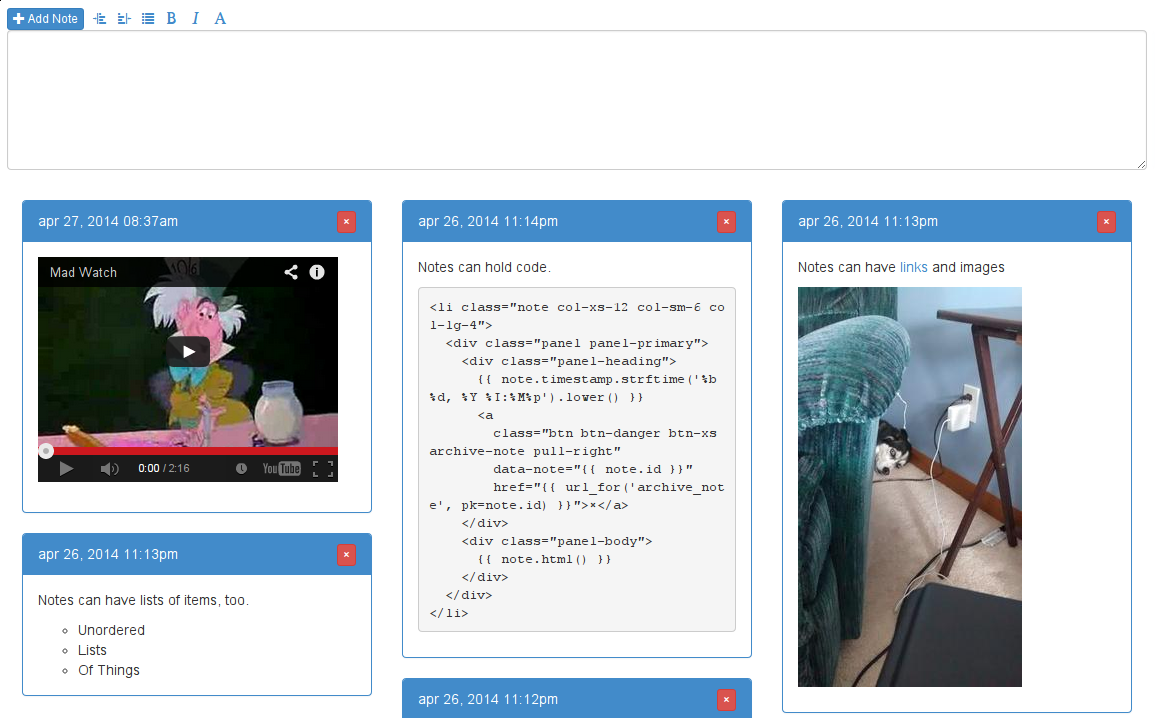
And this is how it looks now!
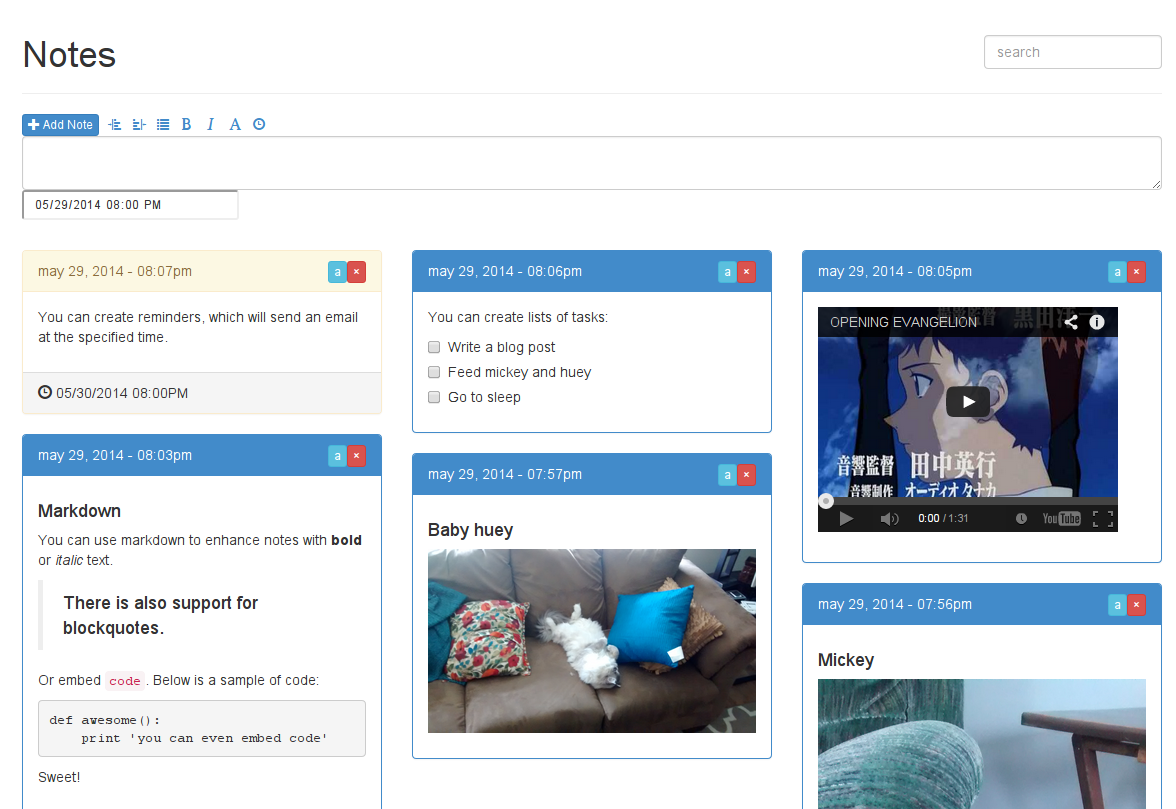
So what's new? Well, I've made a couple changes under-the-hood, and added some entirely new features to the UI.
- Allow creation of Task Lists with checkbox inputs.
- Create reminders that will send me an email at the appointed time.
- Built a RESTful API to interact with the
Notemodel. Thanks to flask-peewee everything comes "for free". - Added search.
- Added pagination (using Ajax).
This was super fun to hack on so I thought I'd share the new code and describe how I added these features. Honestly, I didn't really end up adding much in terms of implementation. Huey handles scheduling and sending the email reminders, even automatically retrying messages that fail to send. Similarly, Flask-Peewee's REST API provides search and pagination out-of-the-box, so all I had to do was write the JavaScript to communicate with it. Thanks to these libraries, I was able to focus on the things that made this project unique, and hopefully you enjoy reading about the code.
Read the rest of the post for the details.
Saturday morning hacks: Building an Analytics App with Flask
A couple years back I wrote about building an Analytics service with Cassandra. As fun as that project was to build, the reality was that Cassandra was completely unsuitable for my actual needs, so I decided to switch to something simpler. I'm happy to say the replacement app has been running without a hitch for the past 5 months taking up only about 20 MB of RAM! In this post I'll show how to build a lightweight Analytics service using Flask.
Creating a personal password manager
My password "system" used to be that I had three different passwords, all of which were variations on the same theme. I maintained a list of sites I had accounts on and for each site gave a hint which of the three passwords I used. What a terrible scheme.
A couple weeks ago I decided to do something about it. I wanted, above all, to only have to remember a single password. Being lately security-conscious, I also recognized the need for a unique password on every site.
In this post I'll show how I used python to create a password management system that allows me to use a single "master" password to generate unique passwords for all the sites and services I use.
AsyncIO

I'd like to put forth my current thinking about asyncio. I hope this will answer some of the questions I've received as to whether Peewee will one day support asyncio, but moreso I hope it will encourage some readers (especially in the web development crowd) to question whether asyncio is appropriate for their project, and if so, look into alternatives like gevent.